Emily Dickinson noted that “We play at paste — | Till qualified, for Pearl —” so bear with me, friends.
Today we look at “On Winter’s Margin,” an early poem by Mary Oliver dating from the mid-1960s (her first volume having appeared in 1963).

You’re thinking of the Mary Oliver who more or less abjured meter, the capitalization at the head of each line, and what I’ll call legacy forms in her slim volume about writing poetry; the Mary Oliver who could write a stanza like
Finally,
the slick mountains of love break
over us.
The point I want to make is simply that “On Winter’s Margin” looks for all the world like an amalgam of a Spenserian and Petrarchan sonnet, albeit with 5- and 7 lines in the first two stanzas, respectively, which doesn’t quite fit either mold. Laying it out as she does with that concluding couplet constitutes an unmistakable nod to the sonnet tradition, at least. Something like iambic pentameter rules, and the ear responds with pleasure to combinations such as win/gin (l. 1), forged/flocking (l. 2), gar/char (l. 3), and so on.
One notices that stanza 1, with its imperative (“See”) is descriptive and objective; stanza 2 zooms in on the poet (or the poet’s puppet) with its threefold repetition of “I” — again reminding me of Shakespeare’s method of moving from the impersonal to the personal. The couplet, as we’d expect, brings it home with a breathtaking swoop — “They are what saves the world” — although ending with “squalor” suggests a more complicated view for which the poem has not necessarily prepared us.
Yes, I admire it.
]]>Also yesterday, I submitted five pages of verse, as required, to the North Carolina Poetry Society, which offers a weeklong residency at Weymouth (the Weymouth Center for Arts and Humanities in Southern Pines). I’ve stayed there before a few times while working on plays, and I found those weeks productive and pleasant.
Along with the tedious grant application I gave them a few poems, including “Dinosaurs in the Yard”:
Dinosaurs will come and go if you treat them right.
Mornings, I wake to their boasts:
“Look at me! Look at me now!” chirks the chickadee
while a catbird practices twelve-tone scales.
A cardinal robed like a pope
(his reach exceeding his grasp)
locates the birdbath: “Bella! Bella!”
The junco, with her courtesan’s eye,
trills one ironic note like a busted gamba.
Ten thousand throats in a saurian welter
that Plato would love, though your ear
rewrites their ropy chants in a tongue
repurposed for those born in beds,
not nests–those apt to die like swans,
singing.
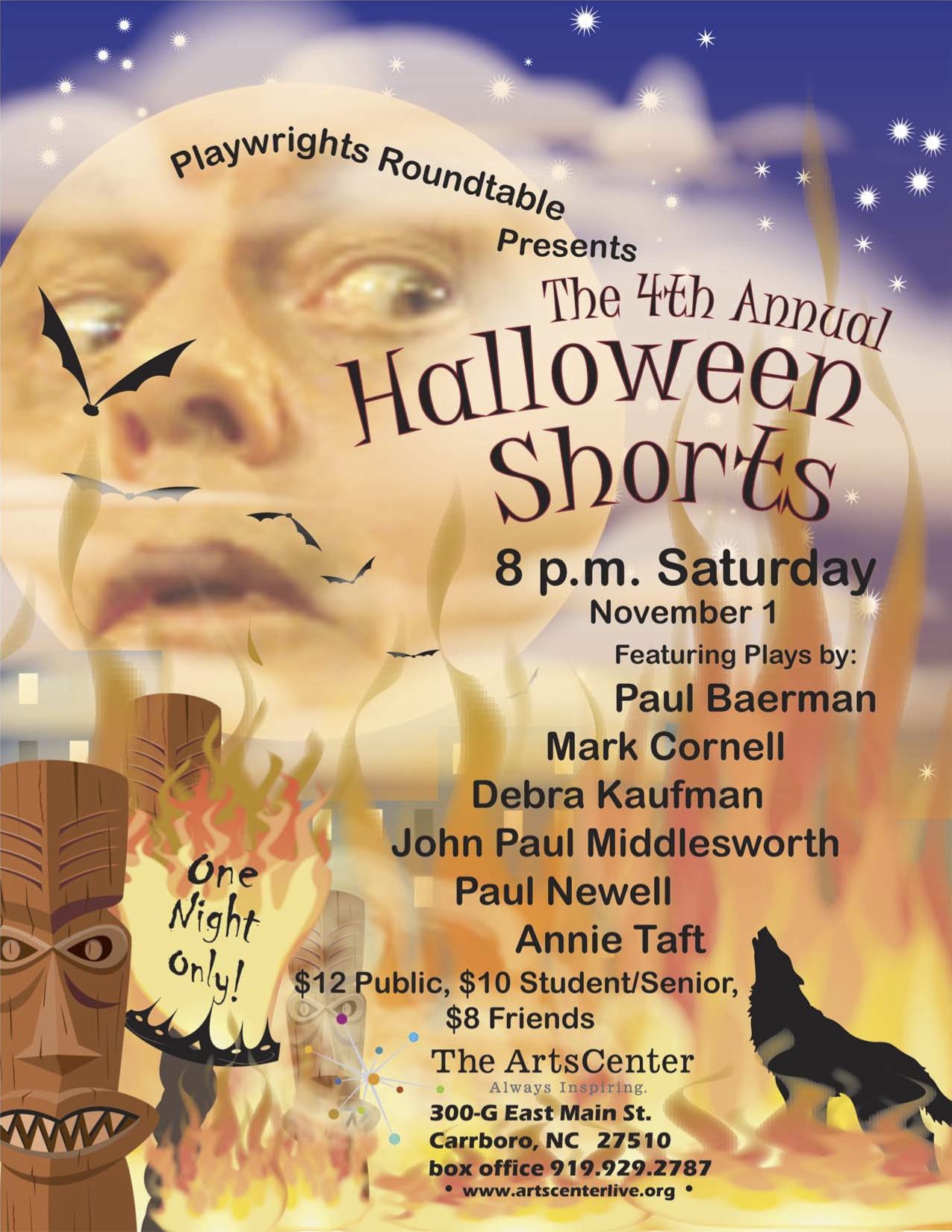
]]>Admittedly, my three lovely ladies endure strained conjugal relationships. There’s Cassandra, who hopes to become an IRS accountant and just wants everyone to get along; Sunny, who used to train assassins but now just wishes for a little furball with fangs; and their hostess, Allegra, who craves revenge for her being mortal.
Enter Allegra’s husband, Rupert the Werewolf, a cardiothoracic surgeon. Shall I say more? Probably not.
See you at 8 pm November 1st at the Carrboro, NC Arts Center.